
Affiliate Disclosure
This article contains affiliate links to products on Amazon and other retailers. When you purchase through our links, we may earn a small commission at no additional cost to you. This helps support our content creation and allows us to continue providing detailed, unbiased reviews and buying guides.We only recommend products we genuinely believe in and would use ourselves. Our reviews are honest and based on extensive research and testing, regardless of affiliate relationships. Your trust is our priority.
In the precision-driven world of electronic music production, where every frequency matters and sonic accuracy can make or break a track, choosing the right studio monitors isn't just important – it's absolutely mission-critical.
The challenge facing today's electronic music producers goes far beyond simply finding monitors that "sound good." Modern electronic music demands surgical precision in frequency reproduction, exceptional transient response, and the ability to reveal the most minute details in complex, layered productions.
From the thunderous sub-bass drops that define modern EDM to the crystalline high-frequency textures of ambient electronica, your monitors must translate every nuance with scientific accuracy. Industry analysis reveals that the most successful electronic music producers rely on monitoring systems that offer both analytical precision and creative inspiration.
The genre's unique characteristics – synthesized sounds, digital processing artifacts, extreme dynamic range, and frequency-spectrum complexity – create monitoring demands that differ significantly from traditional acoustic music production.
This comprehensive professional review examines the cutting-edge studio monitors specifically engineered for electronic music production excellence. We'll explore how advanced driver technologies, room correction capabilities, and frequency response characteristics impact your ability to create electronic music that translates perfectly across:
- Streaming platforms with their loudness standards
- Club sound systems with massive sub-bass requirements
- Consumer devices from earbuds to car stereos
- Professional mastering environments for commercial releases
The Electronic Music Monitoring Revolution: Technical Analysis
The evolution of electronic music production has fundamentally redefined studio monitoring requirements. Where traditional music production focused primarily on capturing and reproducing acoustic instruments in natural spaces, electronic music creation demands monitors capable of handling synthesized waveforms, digital artifacts, and frequency ranges that push the boundaries of human hearing.
Digital-First Production Demands
Modern electronic music lives entirely in the digital domain during creation, making monitor accuracy paramount. Unlike acoustic recordings that benefit from natural resonances and harmonic content, synthesized sounds can reveal monitor colorations and inaccuracies with brutal honesty.
Key requirements include:
- Uncolored frequency response across the entire spectrum
- Minimal harmonic distortion to preserve digital precision
- Accurate transient reproduction for digital percussion and effects
- Phase coherence for complex stereo processing
Extreme Frequency Spectrum Requirements
Electronic music regularly explores frequency extremes that challenge conventional monitoring:
- Sub-bass synthesis can extend below 20Hz
- Digital harmonics reach well beyond 20kHz
- Bass music and techno demand accurate low-frequency reproduction
- Ambient and IDM require pristine high-frequency detail
Modern genres demand monitors that reproduce these extremes without compression, distortion, or frequency rolloff that could mislead mix decisions.
Transient Complexity and Spatial Design
Electronic music features transient characteristics unlike any acoustic source. From razor-sharp digital percussion attacks to complex synthesizer envelope shapes, monitors must respond instantly and accurately.
Additionally, the stereo field in electronic music often serves as a compositional element rather than simply capturing natural acoustic spaces. Producers use precise panning, stereo widening, and spatial effects as creative tools, requiring monitors with excellent stereo imaging and minimal phase anomalies.
Integrating Professional Studio Monitors for Electronic Excellence
The heart of any professional electronic music production environment lies in the strategic selection and integration of studio monitors that can handle the genre's unique demands. Let's explore how specific products can elevate your electronic music production capabilities.
Featured Spotlight: M-Audio BX3 Studio Monitors
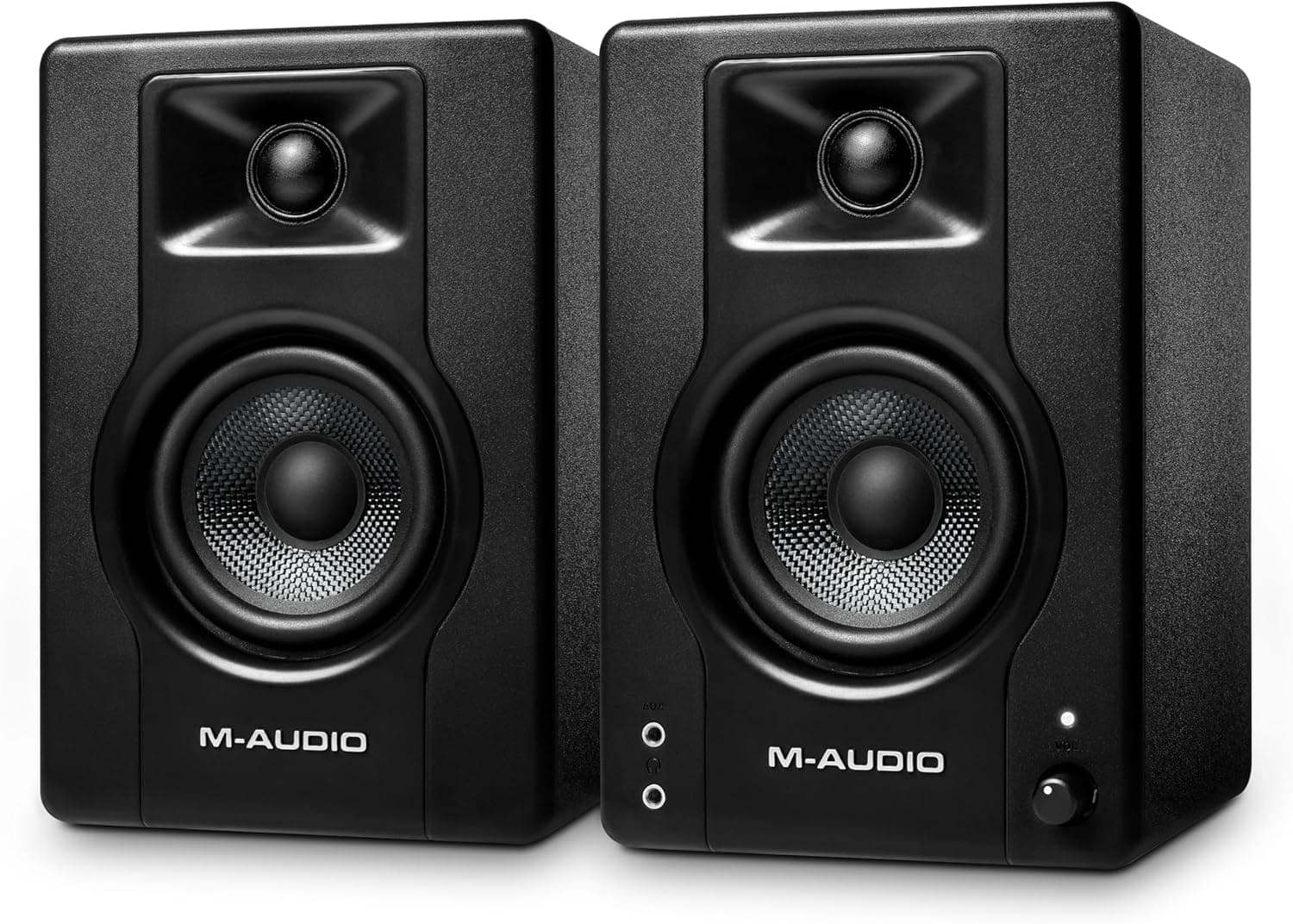
M-Audio BX3 3.5" Studio Monitors
Key Features:
- ✓120-Watt powered Studio Speakers
- ✓3.5" Kevlar low frequency drivers and 1" natural silk dome tweeters
- ✓Computer-optimized tweeter waveguide for precise imaging
Excellent choice for music production with M-Audio quality and proven reliability.
We earn a commission if you make a purchase, at no additional cost to you.
The M-Audio BX3 3.5" Studio Monitors represent an intelligently designed entry point into professional electronic music monitoring. These compact powerhouses pack advanced driver technology and acoustic engineering specifically optimized for near-field electronic music production applications.
Key Electronic Music Production Advantages:
- Kevlar Low-Frequency Drivers: The precision-engineered 3.5" Kevlar woofers deliver tight, controlled bass response essential for electronic music's complex low-end arrangements, providing clarity without the muddiness that can plague budget monitors
- Natural Silk Dome Tweeters: The 1" silk dome tweeters offer smooth high-frequency reproduction without digital harshness, crucial for extended sessions working with bright synthesizer sounds and digital effects processing
- Computer-Optimized Waveguide: Advanced tweeter waveguide design ensures precise stereo imaging essential for electronic music's sophisticated spatial arrangements and stereo field manipulation
- 120-Watt Bi-Amped Power: The dedicated amplification provides clean headroom for electronic music's dynamic range demands while maintaining clarity at both whisper-quiet and club-level volumes
Professional Electronic Music Applications: The BX3's compact form factor makes them ideal for modern electronic music production environments where space efficiency matters. Their frequency response profile specifically benefits electronic music production, offering clear midrange representation where most critical mix decisions occur. The monitors excel at revealing subtle synthesis artifacts, digital compression effects, and stereo processing nuances that define professional electronic productions.
Multi-Product Section: Building Your Electronic Music Monitoring Arsenal
Professional electronic music production often requires multiple monitoring perspectives to ensure mix translation across diverse playback systems. Building a comprehensive monitoring setup enables producers to make informed decisions that work everywhere from streaming platforms to festival sound systems.
Quick Reference: Essential Electronic Music Monitor Features
| Feature | Importance for Electronic Music | M-Audio BX3 Performance | Professional Considerations |
|---|---|---|---|
| Frequency Response | Critical (20Hz-20kHz accuracy) | Good (50Hz-22kHz) | Supplement with subwoofer for sub-bass |
| Transient Response | Essential (digital precision) | Excellent (Kevlar drivers) | Ideal for electronic percussion/beats |
| Stereo Imaging | Vital (spatial design) | Very Good (optimized waveguide) | Perfect for complex stereo arrangements |
| Power Handling | Important (dynamic range) | Good (120W bi-amp) | Adequate for small-medium rooms |
| Room Correction | Beneficial (home studios) | None (manual positioning required) | Consider acoustic treatment investment |
Application Insights: Mastering Electronic Production with Professional Monitors
Let's explore specific scenarios where proper monitor selection transforms electronic music production capabilities.
Sub-Bass Frequency Management: Electronic music's sub-bass content requires monitors capable of reproducing frequencies below human hearing while maintaining accuracy in the tactile bass range (40-80Hz). The BX3's response, while limited to 50Hz, provides sufficient reference for most electronic music applications when combined with proper room positioning. For bass-heavy genres like dubstep or techno, consider supplementing with a dedicated subwoofer for complete low-frequency monitoring.
Digital Artifact Detection: Electronic music production involves extensive digital processing that can introduce unwanted artifacts. Quality monitors like the BX3 reveal subtle digital aliasing, quantization noise, and plugin artifacts that might be masked by inferior monitoring systems. This transparency enables producers to make informed decisions about processing chains and digital effects applications.
Stereo Field Precision: Modern electronic music utilizes sophisticated stereo processing techniques including mid-side processing, stereo widening, and precise panning automation. The BX3's optimized waveguide design provides accurate stereo imaging that helps producers position elements precisely in the stereo field while maintaining mono compatibility.
Dynamic Range Optimization: Electronic music often features extreme dynamic contrasts, from ambient whispers to explosive drops. Monitors must handle these contrasts without compression or distortion while revealing how limiters and compressors affect transient information. The BX3's 120-watt bi-amplified design provides sufficient headroom for these dynamic demands in typical production environments.
For more in-depth technical reviews and electronic music production insights, visit Sound on Sound Magazine. For cutting-edge electronic music production tutorials and techniques, check out Attack Magazine.
Contextual Buying Guidance: Investing in Your Electronic Sound
Choosing the right studio monitors can transform your electronic music production capabilities. Here's strategic guidance for producers at different levels:
- Beginner Electronic Producers: The M-Audio BX3 at $112.49 offers exceptional value for starting your electronic music journey. These monitors provide the accuracy needed to learn proper mixing fundamentals while remaining accessible to new producers.
- Intermediate Producers: Consider upgrading to larger monitors with extended frequency response as your skills develop. The BX3 serves as an excellent secondary reference, while larger monitors handle complex electronic arrangements with greater authority.
- Professional Electronic Music Producers: Build a comprehensive monitoring system incorporating multiple perspectives. Use precision monitors like the BX3 for detail work and larger monitors for impact and sub-bass content evaluation.
When making purchasing decisions, consider your production style, room acoustics, and long-term creative goals. Electronic music production benefits from multiple monitoring perspectives, so building a system rather than seeking one "perfect" monitor often yields better results.
Frequently Asked Questions (FAQ)
What makes studio monitors different for electronic music production?
Electronic music monitors must handle synthesized waveforms, extreme frequency ranges, and digital artifacts with surgical precision. The M-Audio BX3 exemplifies these requirements with Kevlar drivers and precision waveguide design.
Do I need a subwoofer for electronic music production?
While monitors like the BX3 provide good bass response, sub-bass heavy genres benefit from dedicated subwoofer monitoring to accurately judge content below 50Hz that's crucial in electronic music.
How important is room treatment for electronic music monitoring?
Room treatment significantly improves monitor accuracy, especially for electronic music's precise frequency content. Even budget monitors like the BX3 perform dramatically better in treated spaces.
Conclusion
The world of electronic music production demands monitoring systems that can match the precision and creativity of modern synthesis and digital processing. Studio monitors like the M-Audio BX3 provide the analytical accuracy needed to make informed decisions while maintaining the musical engagement essential for creative inspiration.
As electronic music continues to evolve and push sonic boundaries, your monitoring system must serve as both a precise analytical tool and a creative partner. The principles and products covered in this guide provide a solid foundation for building monitoring capabilities that will grow with your skills and creative vision.
Remember that great electronic music isn't just about having impressive gear – it's about understanding how each tool serves your creative goals. With the right monitors and a commitment to developing your critical listening skills, you can create electronic music that translates beautifully across all playback systems and moves audiences worldwide.
Pro Tips for Electronic Music Monitor Usage in 2025
- A/B Reference Testing: Regularly compare your mixes on monitors against professional electronic music releases to calibrate your ears and identify mix translation issues.
- Volume Level Consistency: Mix at consistent, moderate levels to maintain objective decision-making and prevent ear fatigue during long electronic music production sessions.
- Frequency Isolation: Use spectrum analyzers alongside monitors to verify frequency content that might be difficult to hear, especially in sub-bass regions.
- Multiple Listening Positions: Check your electronic mixes from different positions in your room to identify potential acoustic problems and ensure consistent translation.
- Monitor Burn-In: Allow new monitors to break in for 40-100 hours of playback before making critical mix decisions, as driver characteristics can change initially.
Glossary: Essential Terms for Electronic Music Monitoring
- Frequency Response: How accurately monitors reproduce different frequencies across the audible spectrum (20Hz-20kHz).
- Transient Response: The monitor's ability to accurately reproduce sudden changes in audio level, crucial for electronic music's sharp attacks.
- Stereo Imaging: The monitor's capability to create accurate spatial representation of left-right positioning in stereo content.
- Room Correction: Digital processing that compensates for acoustic problems in your listening environment.
- Bi-Amplification: Separate amplifiers for woofers and tweeters, providing better control and reduced distortion.
- Near-Field Monitoring: Close-range listening designed to minimize room acoustic influences on what you hear.